
Understanding concentration risk in emerging markets

Understanding concentration risk in emerging markets
What is concentration risk?
In essence, concentration risk is the danger that a portfolio relies too heavily on a small number of investments or exposures, making it vulnerable if those holdings perform badly.
Why does it matter in an emerging markets context?
One of the most important themes in today’s investment landscape is the growing concentration within equity markets. While this has been widely discussed at length in developed markets, particularly within US equities, it is increasingly relevant within Emerging Markets (EM) as well.
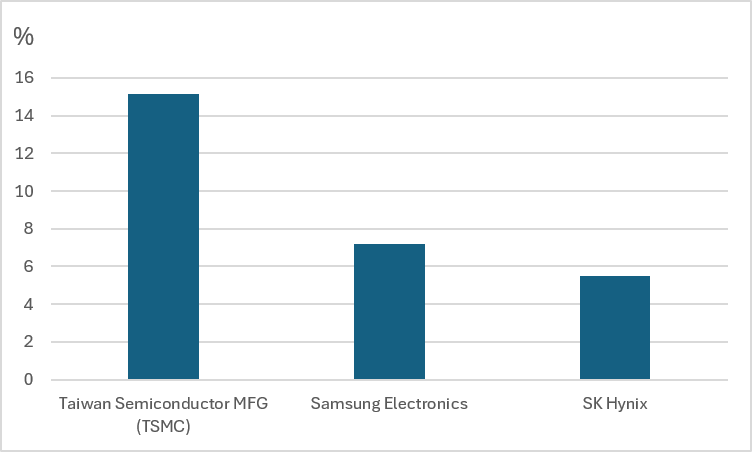
EM indices have become increasingly concentrated, with a small number of countries and companies accounting for a significant proportion of index returns. For instance, at the individual company level, TSMC, Samsung Electronics and SK Hynix now make up nearly 30% of the entire EM Index. This means investors buying passive market-cap weighted EM exposure may be taking larger country, sector and stock-specific risks than they realise. Indeed, as at the end of August 2026, TSMC alone represented more than 15% of the MSCI EM Index.
Chart: Index weights (%) of the top three constituents in the MSCI EM index – Source: MSCI, 31 August 2026
From our perspective, this high level of concentration reinforces the case for active management in certain areas of public markets. Our investment philosophy is built on the belief that active management should only be employed where there is a strong likelihood of delivering better risk-adjusted outcomes than passive alternatives. Emerging Markets remain one of the areas in public markets where we see a compelling rationale for active management.
The EM universe remains less researched, less efficient and more influenced by local political, regulatory and governance factors than many developed markets. This creates opportunities for skilled active managers to identify businesses with attractive long-term fundamentals while avoiding areas where risks are not adequately reflected in valuations.
Active management also provides an important tool for managing concentration risk. Rather than mechanically allocating capital based on market size, active managers can construct portfolios that are more diversified across countries, sectors and investment styles. This can help reduce reliance on a handful of dominant companies and create a broader range of return drivers.
Drawing on our institutional heritage, we will always look beyond traditional asset class labels to understand the true sources of portfolio risk. We focus on ensuring diversification across economic drivers, regions, sectors and investment factors rather than simply maximising the number of underlying holdings. Indeed, this institutional approach helps avoid hidden concentrations and supports more resilient portfolios.
While concentration can deliver strong returns for a period, it can also increase vulnerability when market leadership changes. By combining disciplined portfolio construction with selective active management in areas such as Emerging Markets, we believe investors can access long-term growth opportunities while maintaining a more balanced and diversified risk profile.
Daniel Nilsson is a senior portfolio manager at Isio
