
Putting loved ones first with tax efficient planning

Inheritance tax planning
The inheritance tax (IHT) nil-rate band of £325,000 has been frozen since 6 April 2009. In addition, the Government has confirmed that IHT thresholds, including the residence nil-rate band of £175,000, will remain frozen until at least 5 April 2031.
Furthermore, nearly all unused pension funds/death benefits will be included in an estate’s value from 6 April 2027, making even more people’s estates likely to be subject to large IHT bills. Increasingly, individuals are looking at ways they can reduce or eliminate the tax burden.
One way to do this is by using a loan trust – this helps to freeze the size of someone’s estate and increases the amount that can be passed on to loved ones.
How a loan trust works
A trust is set up, either with a nominal amount (i.e. £10) or just a simple promise to loan the trust some money. The settlor then makes a loan to the trustees, which is interest free, but repayable on demand. The loan is subsequently invested by the trustees, usually within a life assurance investment bond.
The loan remains in the settlor’s estate for IHT purposes. However, any growth on the investment is outside the estate and will be for the benefit of the trust beneficiaries.
The settlor can request repayment of the loan if they require access to the capital, whilst the trustees are able to withdraw up to 5% of the bond investment each year without any immediate liability to tax – These tax deferred withdrawals can be used to make repayments of the loan as and when the settlor requires.
Note that the 5% tax deferred withdrawal allowance is cumulative, so any unused part can be carried forward to future years. As unused allowance isn’t lost, this gives flexibility to allow the invested loan time to grow before any repayments start.
Benefits of a loan trust
A loan trust can be a great estate planning tool, shielding investment growth from IHT without locking away the settlor’s access to their original capital. Some key advantages are as follows:
- The loan is not a gift – this mean that a potentially exempt transfer (PET) or chargeable lifetime transfer (CLT) isn’t triggered when it’s set up.
- Although the outstanding loan remains inside the estate, any investment growth is outside the estate immediately.
- The settlor can use repayments of the loan to create a regular (tax deferred) income.
- The settlor retains full access to their money, so can request larger repayments of the loan at any time
- Loan repayments spent by the settlor further reduces the estate for IHT purposes.
- Where the settlor doesn’t require loan repayments, more money remains invested. This increases the potential investment growth for the trust beneficiaries.
- The settlor can write off all or part of the loan at any time (treated as a gift) to further reduce their taxable estate for IHT purposes – Waiving £3,000 of the loan each year can offer a useful way to utilise the settlor’s IHT gift allowance (their ‘annual exemption’).
- The settlor will normally be a trustee. This means they retain a high degree of control over who eventually benefits from the fund and when.
Example – Reggie
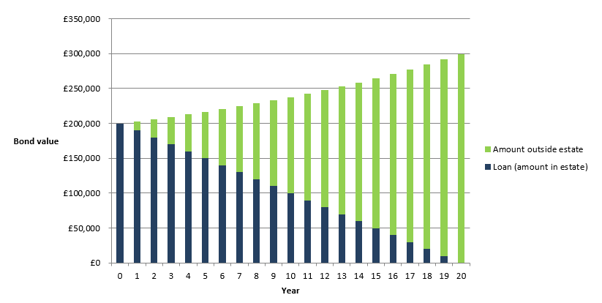
Reggie (70) sets up a trust and makes an interest free loan to the trustees of £200,000. This is invested in a bond that returns 5% a year, after all charges. At the end of each year, Reggie will ask for a loan repayment of £7,000, which he will use as income in retirement. He will also write off a further £3,000 (using his inheritance tax gift exemption each year).
The 5% tax-deferred withdrawal allowance on the bond equates to £10,000 a year. The trustees can therefore make the £7,000 loan repayments to Reggie without incurring a chargeable gain or any immediate tax consequences.
The £3,000 Reggie writes off each year is a gift, so this won’t require the trustees to make any further withdrawals and won’t use up any more of the bonds’ tax-deferred allowance.
If Reggie dies when some of the loan is still outstanding, any investment growth would be outside his estate and therefore not assessable for inheritance tax. Based on the above assumptions, after 20 years the loan will be fully repaid and the bond worth £299,198. This value is now outside Reggie’s estate and is not assessable for inheritance tax, as illustrated below:
Example 2 – Reggie needs a lump sum
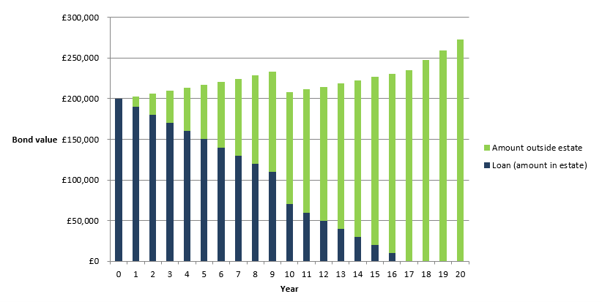
Taking the example slightly further, let’s say Reggie has an unexpected expense in year 10 (for instance, to pay for a wedding or new car) and requires an additional £30,000 loan repayment.
To date, only £7,000 of the £10,000 (5%) tax-deferred withdrawal allowance has been used each year. The trustees therefore can repay Reggie the £30,000 requested from the bond without incurring an immediate chargeable event (£3,000 unused allowance x 10 years).
This additional repayment means that the loan will now be fully repaid after 17 years. This results in Reggie’s £7,000 a year income ending 3 years earlier. After 20 years, the bond is now worth £272.399 (illustrated below):
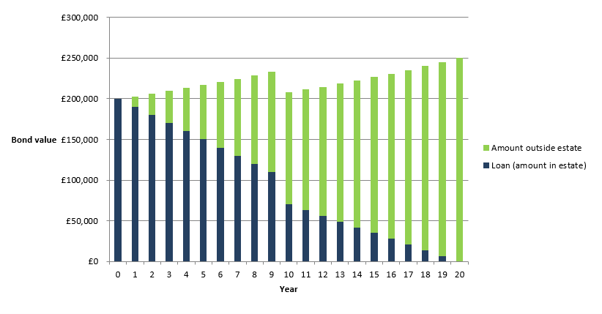
However, if Reggie needed the £7,000 a year to last longer, he could end the regular £3,000 loan write-offs each year. If these £3,000 gifts stopped in year 10 (the same year he asked for a £37,000 loan repayment), the £7,000 loan repayment income could still continue until year 20, when the bond would now be valued at £250,331 (see below):
Technical commentary
Loan trusts provide an excellent way to tackle inheritance tax. However, planning is needed to cover situations when death occurs before the loan is fully repaid.
When setting up the loan trust, the settlor should also consider updating their Will at the same time, gifting any outstanding loan to either the trustees or an individual. If this is not covered, the loan may need to be repaid on death, resulting in the trustees having to encash the bond investment. This could unnecessarily create an income tax liability.
Important information
Please note this is for general information only and is based on LV’s understanding of the relevant legislation and regulations and may be subject to change.
The tax treatment of benefits depends on individual circumstances and may be subject to change in the future.
The use of this document is at your own risk, and the content should not be used for the provision of professional advice.
LV= accept no liability for any damages, losses or causes of action of any nature arising from your use of this document.
At LV=, we have a qualified and experienced Technical Team who work hard to make more complex areas of financial planning easy to understand. Browse our most popular insights and access all of our technical bulletins via our Technical Hub.

LV=
AdviserSupportTeam@lv.com